Right. Apparently these days everyone and their dog has to have a narrative about how Greece came to carry the massive debt burden we currently do. Some have done their homework before taking virtual pen to virtual paper, but many have not, so what you usually get is a quick overview of the current situation, and then some abstract bullcrap that could apply to any country, anywhere in the world and basically reiterates whatever political or theoretical prejudices the commentator has brought to the story.
But the common denominator for most is that they all start the story too near to the present day. Euro accession; the last Conservative government; the financial crisis. It's easy to fit a couple of years to the trend one has in mind, and yet miss the point spectacularly.
Take a look at this graph, showing the trajectory of Greek debt/GDP. This is the stuff your narrative has to account for. Where would you start telling the story?

Sources: IMF (database overview and dataset), recent data (2012 onwards) updated from Eurostat, forecasts from the OECD, IMF and European Commission.
I do not intend to write an economic history of modern Greece in this post. Only to fill in the gap the majority of commentators won't touch. Hopefully readers will do their own research and beef this up.
You see, as precipitous as the rise in national debt has been over the last couple of years, it is still amateur stuff compared to the way we piled on the debt between 1981, the year of Αλλαγή, the Change, ushered in by a massive 48% majority, (Time coverage here) and 1993, when the Maastricht rules finally started to bite and we were forced to pull the handbreak on our burgeoning government budget.
[Note than in 1993 the massive growth in the stock of debt is due to Greece being forced to recognise a big chunk of previously off-balance sheet debt, most of which was built up in the 80s. The actual deficit was much smaller than the jump in liabilities would imply.]
The years between 1981 and 1993 were, despite the protests of deathbed convertees and defaultniks, the years in which the Greek people were the most politically active. Voter turnout in those years was the highest we've ever had - reaching an eye-watering 84.5% in 1989. The politicians didn't sneak this debt past us and onto the nation's balance sheet; we watched them do it and urged on. Worse, once the gravy train ground to a halt, the Sainted People suddenly lost interest in centrist 'politics' altogether. The first elections after that, in 1996, were a washout, with voter turnout collapsing and only the parties of the non-governing Left gaining any ground at all.

Data source: Institute for Democracy and Electoral Assistance.
And incidentally the years under Big Spender A-Pap just so happened to be the times in which the Greek people were the happiest with the state of Democracy in Greece. Apart from the time when we were hosting the Olympics; you know, the ones Debtocracy claims were a massive scam and somehow made a decisive difference to the dynamics of Greek debt.

If you're still in doubt as to whether 1981 was a popularly endorsed change of course, have a look at the video below. You will find that the crowds gathered in the centre of Athens put our current protests to shame. Yes that is our current Prime Minister's dad. The irony would be delicious if we didn't have to pay a terrible price for it.
The Greek people's dilemma in 1981 was framed in the most polarised of terms, as a battle between the Establishment of the Privileged v. Change for the dispossessed (more reading here). The goal of both sides was to capture the State, the ultimate redistributive mechanism. The Sainted People chose the latter by a landslide.
Within a single year, the Keynesian dreams of the Socialists had descended into disappointment (see a sympathetic but critical review here) and a new consensus began to be forged. As Spourdalakis puts it:
In this epic post, Pseudoerasmus looks into the realities of The Change, and sees a shift from Post-War Orthodoxy to 'Democratic Peronism.' I cannot go into all the details of Pseudoerasmus' argument here (you have to read it for yourselves, and I hear there's a sequel on its way!), but I wanted to focus on one of the post's graphs, based on Maddison Project data. As you can see below, Greece lost ground not just relative to the Eurozone core (as it would later become) during the 80s, but also relative to the rest of the periphery.
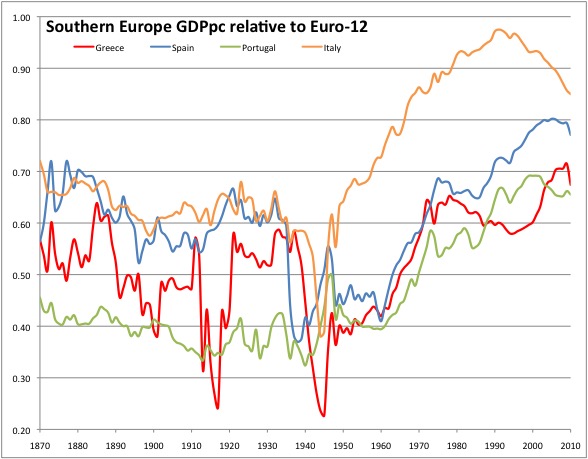
Save for a short period of fiscal consolidation meant to qualify us for Eurozone membership, which, contrary to the flawed hindsight of some, was in fact wildly popular in Greece (see pg. B 29 here and here), we never dropped the Grand Bargain until 2010. We only changed the way it was financed, with the EU and debt markets pitching in to pick up the slack from the overtaxed population. Some people will, upon reading about the smoking gun story of Goldman helping us disguise some of our debt in this process tend to decide they have heard all they need to know and that somehow it was Wall Street that spoon-fed us this debt. Well, there's no helping some people.
In fact, it was the Basel Accords, one after another, that spoon-fed European and other banks our debt, but this is such a long story that it deserves its own post.
Back to our story. By 1993, Greek debt had cleared 100% of GDP and the foundations of the current crisis had been laid. Now, sustaining that level of debt is not impossible, but it is very difficult; it takes a great deal of growth and/or inflation, and as inflation is a terrible tax on the poor and essentially uncontrollable, it was mostly growth that we depended on. By that time, the Greek economy was so dependent on high growth that any slowdown at all was going to be a disaster. Then came the biggest global recession in years, and the rest is history.
Sure, the story goes on, but by that time the dynamics of the Greek fiscal crisis were fixed. Did we have the chance to change course? You bet, long ago. But we didn't.
UPDATE: Commentators seem to be getting their knickers all tangled re: the amount of public spending that trickled down to the people.
I can only refer them to my review of Debtocracy for the figures: left graph shows gov't spending as a % of GDP, right graph shows spending on civil servant salaries (blue) and social benefits (red) as % of government spending.


Eurostat's data don't go back to 1981, which would have been amazing. But you can check the timing of corruption vis a vis the Change by looking at how measures of our underground economy grew during that time (source):

UPDATE: Regarding the data unearthed by our friend @epanechnikov: First of all, many thanks. One objection though. Although this is one very cool table (not least because it shows that PPP-adjusted income in Greece was higher, pre-crisis, than that of Germany, which is simply ludicrous), I should point out that, ceteris paribus, the poorer a population the greater the percentage it tends to direct to consumption of necessary goods and services, assuming similar levels of social security provision (lest someone quote China to me). Similarly, the poorer a population, the greater the percentage of consumption directed towards food (Engel's Law). I'm not sure the Turks, Romanians and FYRoMacedonians were overconsuming.
 A better way of testing consumption is in terms of consumption spending per adult equivalent adjusted for purchasing power, as follows:

This makes more or less the same point but in much less extreme terms: in 2005 Greece's real consumption level was almost exactly at the Eurozone average. Higher than Denmark's, almost the same as Sweden's, and WAY higher than Spain's or Portugal's. Still, without median consumption data we still can't properly argue this point. Perhaps these figures are skewed by a small number of extremely wealthy people - but then again income inequality is only marginally higher in Greece than in Spain and lower than in Portugal (data here) so I'm not sure that is the whole story.
But the common denominator for most is that they all start the story too near to the present day. Euro accession; the last Conservative government; the financial crisis. It's easy to fit a couple of years to the trend one has in mind, and yet miss the point spectacularly.
Take a look at this graph, showing the trajectory of Greek debt/GDP. This is the stuff your narrative has to account for. Where would you start telling the story?

Sources: IMF (database overview and dataset), recent data (2012 onwards) updated from Eurostat, forecasts from the OECD, IMF and European Commission.
I do not intend to write an economic history of modern Greece in this post. Only to fill in the gap the majority of commentators won't touch. Hopefully readers will do their own research and beef this up.
You see, as precipitous as the rise in national debt has been over the last couple of years, it is still amateur stuff compared to the way we piled on the debt between 1981, the year of Αλλαγή, the Change, ushered in by a massive 48% majority, (Time coverage here) and 1993, when the Maastricht rules finally started to bite and we were forced to pull the handbreak on our burgeoning government budget.
[Note than in 1993 the massive growth in the stock of debt is due to Greece being forced to recognise a big chunk of previously off-balance sheet debt, most of which was built up in the 80s. The actual deficit was much smaller than the jump in liabilities would imply.]
The years between 1981 and 1993 were, despite the protests of deathbed convertees and defaultniks, the years in which the Greek people were the most politically active. Voter turnout in those years was the highest we've ever had - reaching an eye-watering 84.5% in 1989. The politicians didn't sneak this debt past us and onto the nation's balance sheet; we watched them do it and urged on. Worse, once the gravy train ground to a halt, the Sainted People suddenly lost interest in centrist 'politics' altogether. The first elections after that, in 1996, were a washout, with voter turnout collapsing and only the parties of the non-governing Left gaining any ground at all.

Data source: Institute for Democracy and Electoral Assistance.
And incidentally the years under Big Spender A-Pap just so happened to be the times in which the Greek people were the happiest with the state of Democracy in Greece. Apart from the time when we were hosting the Olympics; you know, the ones Debtocracy claims were a massive scam and somehow made a decisive difference to the dynamics of Greek debt.

If you're still in doubt as to whether 1981 was a popularly endorsed change of course, have a look at the video below. You will find that the crowds gathered in the centre of Athens put our current protests to shame. Yes that is our current Prime Minister's dad. The irony would be delicious if we didn't have to pay a terrible price for it.
The Greek people's dilemma in 1981 was framed in the most polarised of terms, as a battle between the Establishment of the Privileged v. Change for the dispossessed (more reading here). The goal of both sides was to capture the State, the ultimate redistributive mechanism. The Sainted People chose the latter by a landslide.
Within a single year, the Keynesian dreams of the Socialists had descended into disappointment (see a sympathetic but critical review here) and a new consensus began to be forged. As Spourdalakis puts it:
"the long standing problems of productivity and competitiveness of the Greek economy were to be solved through labour's 'responsible participation' in established tripartite corporatist bodies which would guarantee 'social peace' with wage concessions."The year this Grand Bargain was born was, incidentally, also the year that I was born. One of the most popular ever Greek governments opted not to fix our fundamental competitive problem, but to placate all sides by buying them off. Were the People disappointed? No. In 1985 the socialists won another landslide victory (with a 46% majority) and the saga of the Socialists' οκταετία, the Eight-Year-Rule, was written. The Grand Bargain worked well enough to seduce both parties, Socialists and Conservatives, and an evolved version of it survived up until 2009. This is despite the fact that the Greek eighties technically qualify as a Great Depression; per capita GDP remained stagnant, despite a soaring debt load and money supply. The second half was, if anything, even worse than the first, because the Greek banks finally caught on to the game and public sector spending started to seriously crowd out private investment.
In this epic post, Pseudoerasmus looks into the realities of The Change, and sees a shift from Post-War Orthodoxy to 'Democratic Peronism.' I cannot go into all the details of Pseudoerasmus' argument here (you have to read it for yourselves, and I hear there's a sequel on its way!), but I wanted to focus on one of the post's graphs, based on Maddison Project data. As you can see below, Greece lost ground not just relative to the Eurozone core (as it would later become) during the 80s, but also relative to the rest of the periphery.
Save for a short period of fiscal consolidation meant to qualify us for Eurozone membership, which, contrary to the flawed hindsight of some, was in fact wildly popular in Greece (see pg. B 29 here and here), we never dropped the Grand Bargain until 2010. We only changed the way it was financed, with the EU and debt markets pitching in to pick up the slack from the overtaxed population. Some people will, upon reading about the smoking gun story of Goldman helping us disguise some of our debt in this process tend to decide they have heard all they need to know and that somehow it was Wall Street that spoon-fed us this debt. Well, there's no helping some people.
In fact, it was the Basel Accords, one after another, that spoon-fed European and other banks our debt, but this is such a long story that it deserves its own post.
Back to our story. By 1993, Greek debt had cleared 100% of GDP and the foundations of the current crisis had been laid. Now, sustaining that level of debt is not impossible, but it is very difficult; it takes a great deal of growth and/or inflation, and as inflation is a terrible tax on the poor and essentially uncontrollable, it was mostly growth that we depended on. By that time, the Greek economy was so dependent on high growth that any slowdown at all was going to be a disaster. Then came the biggest global recession in years, and the rest is history.
Sure, the story goes on, but by that time the dynamics of the Greek fiscal crisis were fixed. Did we have the chance to change course? You bet, long ago. But we didn't.
UPDATE: Commentators seem to be getting their knickers all tangled re: the amount of public spending that trickled down to the people.
I can only refer them to my review of Debtocracy for the figures: left graph shows gov't spending as a % of GDP, right graph shows spending on civil servant salaries (blue) and social benefits (red) as % of government spending.


Eurostat's data don't go back to 1981, which would have been amazing. But you can check the timing of corruption vis a vis the Change by looking at how measures of our underground economy grew during that time (source):

UPDATE: Regarding the data unearthed by our friend @epanechnikov: First of all, many thanks. One objection though. Although this is one very cool table (not least because it shows that PPP-adjusted income in Greece was higher, pre-crisis, than that of Germany, which is simply ludicrous), I should point out that, ceteris paribus, the poorer a population the greater the percentage it tends to direct to consumption of necessary goods and services, assuming similar levels of social security provision (lest someone quote China to me). Similarly, the poorer a population, the greater the percentage of consumption directed towards food (Engel's Law). I'm not sure the Turks, Romanians and FYRoMacedonians were overconsuming.
.png)

This makes more or less the same point but in much less extreme terms: in 2005 Greece's real consumption level was almost exactly at the Eurozone average. Higher than Denmark's, almost the same as Sweden's, and WAY higher than Spain's or Portugal's. Still, without median consumption data we still can't properly argue this point. Perhaps these figures are skewed by a small number of extremely wealthy people - but then again income inequality is only marginally higher in Greece than in Spain and lower than in Portugal (data here) so I'm not sure that is the whole story.