NUMBERS ARE PEOPLE COCK-UP BEFORE CONSPIRACY • CITE PRIMARY SOURCES OR GO HOME


Showing posts with label Macroeconomics. Show all posts

Sunday, 28 July 2013

THOSE INEVITABLE EUROZONE CURRENT ACCOUNT IMBALANCES, REVISITED

Health Warning: See Manolis’ comment below and my response regarding the figures. By the looks of it, Eurostat didn't mess any figures up.
One of the core narratives employed in an attempt to explain the Eurozone crisis has always been a variant of the 'global imbalances' theme - the Euro peg puts member states on a treadmill, on which the weighted-average speed of the group sets the pace. If you can't keep up, you rack up current account deficits until you are unable to finance these and fall off. If you can keep up easily, you rack up current account surpluses at the expense of everyone else.

Since most of the trade carried out by Eurozone members is intra-Eurozone trade, the argument goes, it is impossible for everyone to achieve surpluses. The Eurozone treadmill is a zero-sum game, and unless you can lead the race, your best option is to exit.

Well the latest data can be found here, and they show that, at a price, current account deficits can come down within the Euro straitjacket. 


The detailed sources of Greece's adjustment can be seen here. It's mostly down to an improved goods balance, while a reduced net income balance is a distant second. 


'That's a recession for you' I hear some readers snort. Since Greece is in a deep downturn, imports must be falling and therefore the goods balance is improving. Except that's not the case. Looking at the goods balance in detail (data here), reveals the following:


And since better economists than me occasionally read this blog, a puzzle for you. Can you explain what happened to Greece's income debits in 2012 (data here)?


To my regret I was originally unable to, but my reader Manolis spotted the difference - Greek government interest payments. These fell by 2.2 percentage points as a share of GDP between 2011 and 2012 (see p 51 here), so they can probably account for most of the 2.7 percentage points loss of income debits during this period (data here).

My original guess, which I will keep up for historical reasons, was that the change had something to do with tax reform, since income debits spiked in mid 2002, following what was then called the 'mother of all tax reforms'. I theorised that the 2002-3 reforms had forced companies to change the way they used offshore companies to avoid tax, sending an increasing amount of money 'abroad.' I also thought that regulatory uncertainty around the tax reforms of 2012 might have momentarily stopped this flow of income. In fact, following Manolis' contribution, I would still offer my conspiracy theory to anyone trying to understand the remaining 0.5% drop.

For details of the 2002 reforms, and the pre-reform environment, see p. 26 onwards here and the image below:


Saturday, 8 January 2011

YOU CAN HAZ MORE DEATH SPIRALZ!

The IMF and our own Government stuck to their line of -4% growth in 2010 for as long as they could. Then they reluctantly went down to -4.2%.

Now, Eurostat has finally confirmed that the Q3 GDP figure is most likely to end up at -4.6% after all.

Will they never learn?

Monday, 15 November 2010

GERMAN IMPORTS MYTH FAIL

A convenient myth in our national economic collapse (expressed here but also countless other times) is that somehow our rising debts fuelled consumption of German exports.

This argument has been cleverly adapted by our home-grown economists/apologists from the general discussion on Global Imbalances and is correct only insofar as it states that current account surplusses should not be seen as having moral implications (prudent exporters v. wastrel importers). In every other respect it is incorrect.

Now, sadly, figures on bilateral trade balances within the Eurozone are hard to track down - they are not available on Eurostat or ELSTAT. But we have a second-best option.

For proof, turn if you will to page 7 of this publication. It shows that Greece was Germany's 27th largest export market in 2008, down from 24th in 2000 and indeed down from an unbelievable 19th back in 1990. So it's very unlikely that German export growth relied to any extent on Greek profligacy. Note however the rise in the export markets' rank of the US and China, with which German shares neither currency nor any institutional links. If anything, China is a fellow export-driven economy. Of all the PIIGS, only Spain actually went up the ranks of German export markets during the noughties.

Perhaps more importantly, if one could rewing back to 2001, one would read article after article about how badly joining the Euro was playing out for German exports. It turned out the exchange rate at which Germany joined over-valued its products, making it very hard to shift those BMWs (except to Cypriots, bless them). Ten years on the situation is reversed. Germany and some other countries kept running while Greece and some others thought they'd take it easy once they'd passed the big exam.

So there you are, apologists. Greece is not to Germany what America is to China, although it would be convenient and flattering to think so.

Who will we blame our troubles on now? Well, we could still blame them on the Euro. Our Euro is massively overpriced while the Germans' Euro is massively underpriced (evidence here). In this sense Germany is a bit like China - and although Greece is partly a victim of this implicit subsidy, we were given nearly a decade to reverse it by improving competitiveness. Instead, we pegged our wages to those of the Germans (just like they told us not to) and stifled regulatory reform.

UPDATE: A table of Germany's 2009 exports by partner, showing turnover and trade balances, can be found here.

2nd UPDATE: A further discussion of Greece's trade links can be found here

Friday, 12 November 2010

I DAREZ PAUL MUPPET KRUGMAN TO DEBATE TEH AUSTRIAN THEORY

This post is copied from Jeff Harding's post on The Daily Capitalist. I have matched Jeff's pledge and would urge you to do the same. At best, my guy loses and we help feed some hungry people over in NY. At worst, Paul MUPPET Krugman gets his ass handed to him in a symbolic defeat of Keynesian MUPPET running dogs the world over AND we help feed some hungry people over in NY. I'm happy either way.


========================================


I Dare Paul Krugman To Debate Austrian Theory

UPDATED
How much would it be worth to you to see arch-Keynesian Paul Krugman debate a top-notch Austrian theory economist on business cycle theory?
Krugman has prattled for years about Austrian theory being a flawed dead-end of economics. My guess he has never read anything by Mises, Hayek, or Rothbard, the greatest scholars of the Austrian School. He doesn’t understand it in any way; I have read his critiques and they are uninformed.
Robert Murphy, one of the bright young lights of Austrian theory economics, has challenged Krugman to a debate. Now let me say others have tried to draw Krugman out, but he won’t do it. Murphy, who got his Ph.D at NYU, has made an offer of debate that Krugman will be hard pressed to refuse. Here’s the challenge:
When Krugman agrees to debate Murphy at the Mises Institute, $100,000 will be donated to the Fresh Food Program of FoodBankNYC.org, a non-profit dedicated to feeding the hungry of NYC .
Murphy is soliciting donations for the debate through The Point, a web site that hosts campaigns. Launched only 4 days ago, they already have raised $22,000 $28,000 $32,000 57,165. I just pledged $100. If Krugman doesn’t accept the challenge, I will not be charged. If he does, I get a charitable donation deduction to the Food Bank of NYC.
Click the banner below to donate. Please join me. This will be money very well spent.


Badges

UPDATE: Murphy has put up this video of himself prepping for the Krugman debate:


Can you imagine a Keynesian High Priest taking himself this seriously?

Friday, 22 October 2010

Live blogging the LSE Hellenic Observatory Fiscal Policy Conference

*****

Owsiak: change in public debt in Poland unrelated to GDP growth. This is meant to be Laffer-bashing. 75% of Polish state spending is non-discretionary, cannot be cut or re-allocated.

Options? Must review social model. What will be provided by the state? This must be resolved through a Swedish-type social pact. Tax must be reviewed, seen as an investment.

Sure Prof. I'll see tax as an investment when it finances investment. Right now it finances consumption - read your own slides.

Two conditions for social pact: One transparency. Who pays what, for what. And two: imrpoved management: how many civil servants?

Greece's problem also a problem for Poland. Society never knows what public finances really look like.

*****

Prof. Owsiak of the U. Cracow correctly notes an irrational approach to public finances, but says soaring budget deficits due to 'neoliberal' approach to tax as barrier to growth, tax competition by new member states, tolerance of tax avoidance.

Owsiak: time to concentrate on revenue side. Laffer curve does not work.

*****

Back from coffee break: FONDAFIP speaker comments that France is a public spending champion among the EU or OECD nation.

Reformed public finance in 2001, implemented in 2006, including a new 'peformance-centred' rationaly.

FR tries to deliver maximum spending forecasts, has a new comprehensive review cycle and a new 'multi-year planning law'.

*****

Q&A

On role of external auditors, independence of government audit office: there are provisions in the law and efforts to establish a system of internal audit in finmin plus a new directorate to deal with GAO auditing. Gosh sounds pointless.

On moral hazard and government incentives in a world of easy debt and EU money and how to not return to these: Big political obstacles and vague gestures. Tax admin needs to be more autonomous from politicians, departure from partisanship. Some posts are goldmines, people lobby and fight for these.

On bank of Greece monitoring and why no one listened: Question dismissed with shared snickers with Christodoulakis about how the BoG wants to make recommendations to everyone but never wants to reform itself, like all central banks. Answer the question man.

*****

Rapanos: Greek tax offices extremely numerous by oecd standards for clientelist reasons. Tax officers have enormous discretion and can only be transferred with the minister's personal approval. A dd to this frequent tax amnesties destroying credibility and huge backlog of 150,000 tax court cases pending, no dispute reoslution mechanism - a recipe for corruption.

*****

Greek budget has 14,000 items - 6,000 to 7,000 transfers between them annually, each requiring approval.

LOL
- but new law will ban transfers and give more power of control to parliament.

Still now explicit national fiscal rules and lack of commitment, no external auditors (expect hospitals and municipalities I think)

Accrual accounting only on the revenue side.

*****

Rapanos - too much opacity. None or rudimental budgeting in General Gov't despite huge amount of money. Parliament is a rubber-stamp mechanism. The executive has all power on fiscal policy.

Greece needs huge improvement to institution and ex-post auditing, not just on a legalistic basis (e.g. 'Is money spent according to law?' Is pointless. Is it spent correctly and as budgeted?)

Also a need for efficiency measures beyond eu-funded projects.

Finmin control - too little accountability elsewhere. (See earlier note on new budget law)

*****

Rapanos - Greece GDP forecasts optimistic (plus 0.35 percentage points). OECD and EU also over-optimistic.

Even conservatives like the IMF used rosy projections for our fiscal measures.

Sounds like yomamanomocs but he has a point. Everyone was asleep at the wheel.

*****

Rapanos: takes 3 years for preliminary budgeted deficit estimates to be evaluated. Deviations are substantial - targets never met. We're getting revenues wrong consistently since Euro accession, revising downwards.

And that's just Central Gov't - none on local Gov't

*****

Rapanos: Greece missing numerical fiscal rules,independent fiscl councils, medium-term budget framework, budgetary procedures

****

Rapanos is on now - the Chair of NBG. Says commentators misunderstand the Greek fiscal institutionl framework - which is a) crucial and b) missing.

*****

Christodoulakis hails Greece's latest bond issue. Ooh. We're getting cocky.


*****

Greek finmin has sent ms Drosou, hardly an operator. She rolls out the usual blurb and celebrates the new Organic Budget law requiring Greek ministries to have a CFO and take responsibility for their own budgets. Wow.

*****

FONDAFIP: EU "a common house in which we can survive difficult times"


*****

Objective is not to instruct one wayward member but to "learn from one another" - we're all bankrupt anyway!

*****

Prof. Featherstone touches on the CSR in the UK, remembers to moan about the cut to Higher Education budget.

*****

And we're off. Prof. Featherstone looks more like a Greek academic than I though - bit of a jowl, tweed, hideous yellow tie.


Prof. Bouvier can't make it but his wife will stand in. Great start to conference on sound management.

*****

Journos seem to have had a late night - taking their time getting in. The blog's favourite Economist hack isn't here yet either, but is meant to be attending.

*****

Conference Programme available here: lse.ac.uk/collections/hellenicObservatory/pdf/Events/CONFERENCE%20-%20Public%20Financial%20Management%20(22.10.2010)/Programme_for_website.pdf

Looking forward to ex-finmin N. Christodoulakis' contributions. He looks like a nice guy up close, and suitably low-key.

*****

Tune in later today for highlights of the event as they take place. I predict many LOLs.

_____

Monday, 11 October 2010

I CAN HAZ NOBEL?

LOLGreece offers our heartfelt congratulations to the three new Economic Sciences Nobel Laureates - who, it should be noted, received their prize for modelling the implications of search frictions on markets, most notably the labour market. In short, for trying to explain why I don't work in Greece.

Friday, 1 October 2010

IMF STAFF REPORT WIN PART 2

I look forward to the way this paper will be received by the Greek media - if it is covered at all.

From the IMF's latest World Economic Outlook, I give you the aptly named "Will it hurt?", an essay on fiscal adjustment pain. I shall return later with a full analysis of what this is going to mean for Greece, but if you want to try your hand at the calculations, remember that Greece's fiscal adjustment amounts to 11% of GDP. So whatever figures you see in the report, multiply by 11 for a first estimate.

Wednesday, 15 September 2010

DOG ATE MY HOMEWORK, GREEK EDITION

The Government has published today its newest Statement of Intent regarding our standby agreement with the IMF, and the IMF has released its latest review of our stabilisation programme.

At first glance, the two documents (which appear to have been written by the same person) reiterate much of what is already known. Read between the lines, however, and it's not so good anymore. My play-by-play is as follows:

  • tax receipts have collapsed because the economy is imploding much faster than we had expected, but we're holding back spending even further so it's all good (hint: it isn't). We still expect growth to match the -4% forecast we've agreed with the IMF (ed: it won't).
  • we're having a bit of trouble controlling anything outside of central government (nothing to do with the upcoming municipal and prefectural elections) and are making up for this by keeping central government expenditures down:
"Through June, the large margin under the targets created in the state budget has offset the overruns to date in subnational entities. "
  • we've been able to hold back central government spending so much partly because we're putting off payments to our own funds or citizens, a state of affairs often called default.
"However, there has been some undesirable buildup in accounts payable/arrears in hospitals and social security funds."
  • Inflation is out of control, partly "because the government frontloaded a number of large indirect tax increases, which have been passed on as a step up in the price level." We couldn't possibly have foreseen that, even though "[t]he high pass through of indirect tax increases to final prices is indicative of a lack of competition and the prevalence of oligopolistic market structures" which we've known about all along. Actually we don't mind because inflation is also eating away at our mountain of debt - so it's definitely all right. This is what the IMF mean when they say: "Staff and authorities agreed that nominal growth will be somewhat higher than originally anticipated." This puts us on track for debt to GDP of 144% in 2013 rather than the 149% originally forecast. YAY.
  •  Thankfully we can always count on the contribution of pimps, drug dealers and tax cheats to consumer demand: "The authorities saw the risks to the growth outlook as being on the upside. They noted that the informal economy and unrevealed pockets of wealth act as a buffer and underpin private consumption data." It won't be the first time that our shadow growth sector comes to the rescue.

  • We're sorting out our budgeting process. Now all levels of government and all government agencies will be handed actual budgets on a top-down basis (WOW), along with contingency margins (ed: which they will use 9 times out of 10). Our budgets will be part of a UK-style Comprehensive Spending Review, which will do almost nothing to keep us from screwing our grandkids over in the same way that it did for the British. Yay.

  • We now have a much better idea of how many people we employ in the public sector: just under one in five persons in employment. We'll commission a review of the function of public administration to see what we're going to do with them. Even though public admin only accounts for half of the public sector payroll.

  • We've implemented price caps on medicines, forced hospital suppliers to give us a massive discount and accept payment in Greek bonds, all to to keep our health sector from folding. Predictably we are now facing dangerous and humiliating shortages of absolutely every sort

  • We've passed a highly controversial law, codenamed 'Kallikrates', to reform local authorities. Its main function to date appears to be to merge insolvent authorities with solvent ones, the intelligent solution to insolvency so successfully pioneered in the banking sector.

  • We've passed a massively controversial (and much needed) law to reform our terminally ill pensions system. We're pretty sure it will work (the IMF forecasts a saving of 8% to 10% of GDP by 2050) even though "The National Actuarial Authority will complete an assessment of the effects of the reform on the main pension funds by end-December 2010, and of the largest auxiliary pension funds by end-March 2011." If it turns out the system still isn't solvent (ed: it will), we'll just pass another law to amend it, even though passing the first one nearly toppled our government.

  • We will continue our trend for selling ever smaller amounts of ever shorter-term bonds ever more frequently, because nobody will buy them otherwise.

  • Our banking system is in good shape - all but one bank passed the incredibly rigged CEBS Stress Tests, which, by omitting any haircuts on assets held to maturity (like most Greek bonds out there), made our banking system look less doomed than it actually is. "Liquidity conditions have remained strained" is a tactful way of saying that our banking system is losing billions of Euros of deposits per month and would not survive one second without funding from the ECB.

  • We've commissioned a strategic review of options for our banking sector by "independent consultants." Money well spent, as our government have clarified that they want a large part of the sector to remain public and that's that. The IMF helpfully point out that the Greek state has a controlling interest in over 11% of the Greek banking system by assets. Someone ought to tell them we don't take hints very well.
  •  
    Dear friends. Do not be fooled. There is only one thing that matters in all of this sorry saga. Earlier this week the Basel Committee announced that the implementation of Basel III will be phased in over four years, and parts of it will wait until 2019. 2014-15 now becomes the likeliest date of the Greek default, if nothing else goes wrong in the world. Welcome to the end of the world.

Thursday, 26 August 2010

WE ARE NOT [NAME OF DISTRESSED COUNTRY] FAIL PART 2

Apologies for the long interval, dear readers. Even LOLGreeks must work for a living.

However, I have come across a real gem on Alphaville today which I thought I must share with you. A report by Morgan Stanley entitled "Ask not whether sovereigns will default but how".

Remember how the IMF proved to us the other day that we are not Hungary (but would really, really like to be)? I'm sure I got some cheers from the Troktiko-readers back home by pointing out that Ireland and the UK and in worse shape, from an intertemporal budgets perspective, than we are.

Oh, dear. Well it turns out they are not.

You see, unlike the UK and Ireland, Greece is an old, old country. By 2050 over one third of our population will be over 65.


And we're very bad at being old because we believe people over 55 shouldn't work. The British and the Irish may be insolvent but they just might be able to dig themselves out through changes in policy if they can just buy some time. We on the other hand, cannot because we have very little discretion.Our population is ageing and they will need their hospitals, their pensions, their bus concessions and whatever have you.


Unsurprisingly, the Morgan Stanley report finds that we carry a bigger demographic burden than almost any Western country. The IMF can't fix this. The Government can't fix this. They can only work on the two first bands of the graph above, which incidentally only represent about a quarter of our problems.

Good luck Yorgo.

Readers can browse the full MS report below:

MS Default

Monday, 16 August 2010

TARGETS FAIL, WIN, WHATEVER

Welcome, dear friends, to the 100th post on LOLGreece. We’ve come quite a way and I’m grateful for your support. As a token of my gratitude I'm not going to do very much but I do promise to tag all of these posts and maybe add some kind of cool tag graphic. Yay!

The big news this weekend were the latest figures from the Greek statistics agency, which reveal that the Greek economy stands on the brink of a death spiral, clocking in at -3.5% growth. Why anyone is surprised, I don’t know. I won’t even bother to say “I told you so” even though I kind of did, because it should have been obvious to anyone paying attention.

Now, for the facts. First, the 3.5% fall is a year-on-year statistic. GDP actually grew by -1.5% in Q2.

Annualise this and you get a much more dramatic number: -6.1%. Or if you’re feeling more generous, annualise the figures from Q1 and Q2 and we’re on track for -4.6% growth this year. Both of these figures are well in excess of the 4% GDP fall anticipated by the EU and the IMF. Which of the three “annual” figures is the more accurate depends on what you think of the momentum of the Greek economic cycle.

My guess from the data so far (see below) is that we’re not halfway there yet and therefore I’m holding out for the worst-case scenario of a -6% growth figure for 2010.


Where does this leave debt to GDP and the deficit? It’s not too hard to approximate. You can get the latest external debt stats here and can approximate the incremental nominal debt in Q2 2010 based on the Q2 2010 change in our budget shortfall, which can be found here.

The result is a lovely linear upward trend, which has brought our debt to GDP ratio to a wonderful 120%, up from 115% in 2009. We're still some way off the forecast 133.2%, but there's always hope.


The verdict is that we're still way behind. 

Friday, 30 July 2010

WE ARE NOT [NAME OF DISTRESSED COUNTRY] FAIL

Many readers will know that Hungary, one of the first European countries to take the IMF's cursed silver in the recent crisis, has recently experimented with the time-honoured genre of Sticking It to the Man and broken off their relationship with the IMF, forfeiting a sizeable tranche of money.

In light of this, I feel compelled to state in no uncertain terms that we are not Hungary - and even if they manage to pull off this latest piece of brinksmanship, we will never be able to emulate them.

The reason is made clear in a very enlightening paper written by - who else? - IMF staff (who may themselves be starting to suspect that Hungary may just get away with its two-fingered salute and are probably keen to warn the flock against straying too far).

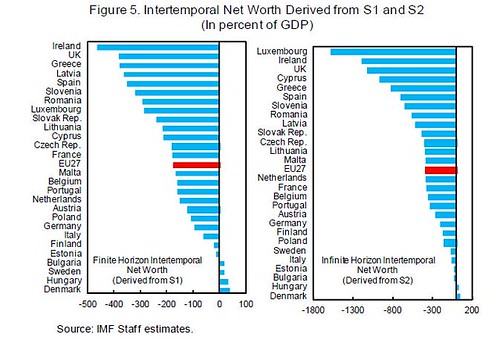
In this massive collection of statporn, the killer graph is the one reproduced below:


What does it say? It says that while Hungary may have some liquidity problems (which can be fixed), Greece is simply insolvent (and in that respect we are in good company, with the UK and Ireland just ahead of us in fact).

Picture the situation like this: If a monstrous, futuristic corporate from a cyberpunk graphic novel were given the right by the IMF to bid for and buy the Greek state (along with our debt), there would be no takers.

Which is good in a way, because at least it means we can have it. That should put the conspiracy theories to rest.

Sunday, 18 July 2010

DEBT TIMELINE WIN

I don't know where this graph came from originally, so I'll credit Troktiko, where I saw the photo in the first place.

People around the interwebs seem to be taking this graph as evidence that Greece's Socialists are to blame for our huge mountain of debt. While I have endless sympathy for this sentiment, that is the wrong way to read the graph.

You see the Socialists actually paid off a good deal of our debt under Simitis and the Conservatives added to it (even above the purely cyclical effect) under Karamanlis Jr.

What actually happened was that the gravy train only stopped on three occasions: under dictatorship, during Papandreou's last (read: senile) days, and under Eurozone convergence. The three situations have one thing in common: the Greek people were unable to influence fiscal policy through clientilist politics either because no-one was listening, or because the people in charge were answering to a higher power.

Enjoy!

Saturday, 17 July 2010

I CAN HAZ COVER STORY?

A little publication for my Greek friends.

You can download the entire issue (in Greek, I'm afraid) here.

I wonder if the people at Proto Thema realise the extreme irony of calling their business inset "Business Stories" and then truncating this to "BS".

It does, however, help to keep my ego from inflating any further.


IMF STAFF REPORT WIN

The IMF is lovin' it.

IMF staff have published today their review of the stand-by arrangement with the IMF which will no doubt make G-PAP and even some of our journos happy. The full report can be read here.

In summary they suggest that reforms are proceeding according to plan and economic growth has only been affected to the extent they had planned for.

I sincerely hope they are right.

However, they also note the following risks to the plan:
  • Out-of-control inflation - only to be expected when one racks up VAT in an economy with a very rigid labour market. 
  • Healthcare and local authority expenditures not entirely under control - primarily because we still don't know what they are
  • Publicly owned enterprises are invoking public sector guarantees on their debt.
  • The pensions reform bill is on track but we don't actually know what savings it will achieve because the actuaries are taking forever to crunch the numbers - not their fault really as the system is too complex in the first place. 
  • Greek banks are still locked out of the interbank lending markets 
  • Too many naysayers are still talking about default - credibility is not yet restored. 

Sunday, 30 May 2010

THE END OF THE LOL – WHY I BELIEVE IN A GREEK DEFAULT

It is time, dear readers, for Greece’s creditors to take a haircut. They’ve had a good run but it’s just not going to work anymore. They made a bad bet on us as on many other risks and now it’s time to take the consequences.

In late 2009, Greece had a small window of opportunity in which to signal in a credible manner that there was more political capital to be made from reducing our liabilities than from increasing them. Similarly we needed to demonstrate that there was more political capital to be made from paying our creditors than from defaulting. I am convinced that this window of opportunity started to close in December and then slammed shut in January, when Joseph MUPPET Stiglitz supposedly came to our aid and our political elite gave up trying to convince the people that we are going to have to change voluntarily.

One after another, our politicians, our journos, and of course our people, came out in favour of a mild adjustment, or none at all. They cried “speculator” until they were hoarse. Our state banks even shamelessly played the CDS market ourselves, making money out of our own profligacy. Commentators threw tantrums, made absurd demands and blamed everyone except themselves (and their respective main constituents) for the state of our country.

Well it’s all over now – for a simple reason. We’ve left things to escalate for so long, let confidence sink so far and borrowing costs rise by so much that the math doesn’t work anymore.

Greece’s real GDP has never in the past 10 years grown faster than 4.8% per annum (see here).

Government revenues have never been more than 43% of GDP and Government spending has never been less than 43.2% of GDP. Expenditures excluding interest on public sector debt have never been lower than 38.8% of GDP (see here).

 The above suggests that we could not, over the past 10 years, ever have run a deficit of less than 0.2% of GDP, let alone a surplus. In actual fact, however, we’ve never run a budget deficit smaller than -2.9% of GDP (see here).

Finally, the informal economy has never been less than 22.6% of GDP (see here) in the past 10 years.

Now, I will assume that everything works out for us within the three years from 2010-03. We bring expenditure and the informal economy to their 10-year minima, and revenues to their 10-year maximum. I am using the IMF’s projections for real GDP growth the GDP deflator (basically the price segment of value added). I assume that the GDP deflator will tail off after 2015, while GDP growth will work out to the IMF’s projections and then gradually converge to our GDP growth maximum of 4.8%.

Under my rather rosy but at least realistic projections, debt servicing costs of anything over 9.25% would mean that our mountain of debt would never fall below current levels and eventually rise to infinity. If the market handed us that kind of interest rate, they would be handing us a death sentence. Unfortunately this came to pass as our 2-yr yields climbed above 20% in early May, courtesy of our army of subsidy-junkies, extortionists and murderers and the idiots who shelter them; hence the EU/IMF bailout. 

So far, so rubbish.

But now we have a different problem – the one at the heart of the Credit Crunch, the Great Recession, and in fact every episode of such in the past half century. In a world of fiat money, all money is debt and no monetary value is truly real. It exists only as long as it’s backed up by a web of implicit guarantees – in practice right up to the people with the biggest and best balance sheet. Hence the pressure on Germany, and potentially on the US, to guarantee everyone’s debt.  

So while have established our guarantors as the markets have demanded, the markets are still unsure they are good for the money. Why? Because if we go under, European sovereigns will have to bail out their own banks, to whom we owed north of EUR70bn last time I checked. They will also automatically become more likely to have to bail out our fellow PIIGS, with which we also have a web of liabilities. The IMF itself doesn’t have enough money by any stretch of the imagination to bail out the PIIGS – Greece is a bit of a stretch actually. So the guarantee is weak and our debt is looking decidedly blurry.

Now we can drag this sorry mess out forever, give up sovereignty over our own country and feed the delusions of Eurocrats for another couple of years before everything comes crashing down. Or we could bite the bullet, prepare for a seriously no-frills existence, and renegotiate our debt.

Is debt restructuring or indeed default a new thing? Historically it most certainly isn’t. Nor is it outside the realms of our recent experience. We have already tried restructuring our hospitals’ debts to suppliers in the past and done so again in May. Many state employees, even some that foreigners are likely to meet, are left unpaid for some time as a matter of course. The state also owes money to its pension funds. In the private sector, any of these things would be called “defaulting”. It is only out of respect for the sensibilities of a sovereign state that people do not call us bankrupt.

Perhaps more importantly, debt markets are pricing a 75% probability of Greek default by July 2015 into the price of insuring our bonds. Our creditors are already taking the damage to their share prices and those who are forced to mark-to-market will eventually take actual losses. The damage is already done.

Finally, it is fair to say our people want a default, as long as it doesn't hit pensions and benefits. That can be arranged.


What we need is an orderly wind-down; a cloak-and-daggers summit of creditors like the one held for Hungary should map our liabilities and the effects of different levels of default on them. Each creditor should come clean on the full extent of their individual exposure and write down an agreed percentage of the debt. Instead of financing us, the IMF will agree support for those banks over-exposed to our debt.

Now let’s see if anyone will bite the bullet and say it.

UPDATE: People have finally cought on to the fact that the restructuring of Greek hospital debt is tantamount to default. H/T To Nick Shay for pointing out this story. 

Thursday, 22 April 2010

EUROSTAT: YOU NO CAN HAZ CHEEZBURGER

So here is it my friends, Eurostat's laconic report on EU Government spending and debt.

You can read it here.

Our deficit for 2009 is apparently 13.6% of GDP, give or take 0.3 to 0.5 percentage points. So if we're quite liberal our deficit could be between 13.1% and 14.1% of GDP.

Our debt is 115.1% of GDP, give or take 5 to 7 percentage points. So the range (as above) is 108.1% to 122.1% of GDP.

Eurostat notes:

Reservations on reported data


Greece: Eurostat is expressing a reservation on the quality of the data reported by Greece, due to uncertainties on the surplus of social security funds for 2009, on the classification of some public entities and on the recording of off-market swaps. Following completion of the investigations that Eurostat is undertaking on these issues in cooperation with the Greek Statistical Authorities, this could lead to a revision for the year 2009 of the order of 0.3 to 0.5 percentage points of GDP for the deficit and 5 to 7 percentage points of GDP for the debt.

Wednesday, 21 April 2010

WE CAN HAS BARGAINING CHIP?

Of course not.

For tomorrow Eurostat will announce our deficit figures past and present as determined by themselves.

Details here: http://www.zerohedge.com/article/tomorrow-eurostat-reports-european-government-deficits-expect-more-pain-greece-downside-surp

The damage? TA NEA rather bizarrely cites itself as reporting a 13.7% deficit/GDP (up from 12.7%) and 120% debt/GDP (up from just over 100%).

Which suggests to me that our GDP has been revised downwards, the stock of nominal debt has been revised upwards and the nominal deficit is not actually that far off the mark.

But this is just a guess. We'll just have to wait and see.

BTW. Please Mom and Dad, if you're reading this, grab all the jewellery and get yourselves and your pension pots out of there.

Wednesday, 14 April 2010

KEYNESIANISM FAIL - PART 2

Not too long ago, I blogged about the findings of a research paper, which suggested that the Greek economy was beyond Keynesian salvation because we had reached the limits of the capital markets' tolerance.

Back then, my rather naive thought experiment suggested that borrowing an extra, say, EUR3bn would cost 150m more than expected as a result of rising interest rates on our public debt.

Unfortunately, the reality has replicated my thought experiment almost to the letter. As reported here,

"When the first austerity plan was presented, Greece cut public sector wages by a painful 10% causing angry protest and social unrest, although it saved the government EUR650m. But the same austerity plan assumed Greece’s interest cost would be 4.7% and by late February it was paying 6.25%. According to the WSJ, this has blown a EUR700m hole in its budget, more than offsetting the savage public sector wage cuts already enacted."
Note that this has happened despite our announcements of an extremely harsh austerity package. Back when I first posted on the subject there were still people calling for more moderate cuts, and our unions of course were arguing for a complete reversal of such. By the power of the Internet, their words are now immortal.

Implementing austerity works only if you do it decisively and quickly, like pulling out a band-aid. Which is precisely what our 2008-9 Keynesian cushion was.


Tuesday, 26 January 2010

WE HAZ HERO! (MUPPETRY ALERT)


It's official - Joseph Stiglitz has come to our rescue, in an article that we are sure to see cited and re-cited ad nauseam for the next few days. His argument goes like this:
  • Greece is not alone in having broken the Stability and Growth Pact. Everyone has, except this once we're not important or powerful enough to get away with it.

  • The EC can afford to disregard some poor conduct from Greece because Greece is nowhere near as systemically important as other members.

  • The EC's hawkish statements and its failure to acknowledge the progress we are making are compounding Greece's fiscal woes by increasing bond spreads.

  • Greece's deficit is not entirely its fault  It's party Europe's fault for not giving us more money

  • Greece has confronted its heritage of dodgy statistics and owned up to its poor practices

  • Greece is a relatively poor country that will be plunged into a very deep recession if we're not allowed to run whatever deficit we want

  • Credit rating agencies are useless at rating debt and they should not be trusted with this role when the stakes are so high.

  • Yorgo personally is a great guy and the EC should back him up. 

I disagree with a great deal of this, and in this I know I am letting down many friends who have welcomed Stiglitz' messianic intervention with much relief. With respect, here are my arguments:

First, the issue of whether anyone plays by the rules anymore. Obviously they don't. But what exactly is Stiglitz' argument? The SGP was the guarantee that underpinned whatever type of solidarity there was between Eurozone economies. That it isn't worth the paper it was written on only suggests that there can be no solidarity between member states. He is right, however, that since nobody gives a hoot about the SGP, bitch-slapping Greece with it is not entirely fair. Why not just allow states to run whatever deficit or debt levels they want?

Credit where it's due. The SGP was rubbish and I agree that as a country we should have opted to set our own rules any way we want. Except of course we signed a treaty to the effect that we would respect the SGP, so perhaps it sets a very poor precedent for the EC to signal it will tolerate the breaking of treaty obligations.


More to the point, we have in the past used the SGP straitjacket as an added guarantee so we could borrow money cheaply. To this day, the suffocating stranglehold of the Eurozone ministers on our finances is the only thing that stands between us and a junk bond rating. What credible guarantee of self-discipline will we be able to offer if the Europeans cannot make us bleed for maxing out our overdraft? And if our own Ministers can't be bothered to bolster our image by refraining from alarmist bull, why should the ECB or the EC supress their thoughts on the actual facts?


So, far from making Greece less creditworthy, hawkish Europeans actually make us more so in the long run. But Stiglitz himself has managed the opposite. As I've argued before, the final guarantee our creditors have is that there is more political capital to be made in Greece from cutting the debt than from adding to it. Stiglitz' remark, on the other hand, has handed anyone who wants to increase the Greek deficit a get-out-of-jail card with at least the liberal part of the political establishment (which, in Greece, is easily 50% of it). This means that it is now politically that much easier for our government to justify an enormous deficit.


Greece's woes, it would appear, are unlikely to cause an EU-wide meltdown - just as Stiglitz argues. Although Europe's banks have lent us some pretty big wads of money, there is no evidence of infection from Greece to our neighbourhood. The point is irrelevant, however. If Spain, Portugal and Ireland were to be given the same amount of slack that Stiglitz wants us to be give (and why not?) they might take it. And if they do, the share of European GDP at risk from massive government deleveraging would skyrocket. The PIGS together account for 14% of the EU's GDP.


The new government has made some very good proposals for restoring credibility. But already the Stability and Growth Programme update shows that we're quite nonchalant with statistics. Our PPP debt, for instance, is largely unaccounted for. And while the EC has applauded us for coming clean with the dodgy practices of the departing government, they also applauded us for our honesty 6 years ago when said government came clean with the dodgy practices of the previous administration. One in which, if any reminder were needed, our own Prime Minister was a Cabinet member. What would be a rational response? Give advice, issue a stern warning, then wait and see. Which is what they've done. The EC can lie on our behalf but that doesn't mean creditors will buy it.


Which brings us to the worst Stiglitz argument of all - it's the EC's fault for not giving the periphery more money. First, in our case that would clearly be throwing good money after bad. We know this and the EC knows this and Stiglitz knows this because our own data show we are amazing at wasting EC infrastructure funds. That is, when we manage to use the funds at all. Second, it's been proven that unless we can shift our budget to investment rather than government wages (which we're not good at doing, especially with other people's money) government spending actually slows economic growth. Finally, we're already prey to the malaise that afflicts all aid-dependent countries: a version of the Dutch Disease where government itself is the bloated export industry, coupled with a perfect environment for corruption. To add to this now would consign the country to stunted growth and financial instability forever.

Friday, 22 January 2010

KEYNESIANISM FAIL

According to the updated Stability and Growth Programme, our current government is committed, despite everything, to a 15.3% reduction in public consumption over 3 years. I'm not sure they can do it, but I'm 100% sure it's the right thing to do, if they can pull it off.

Now not everybody takes my view on this. Our general union for the private sector has, as I've blogged here, made a strong if misguided Keynesian case for fiscal stimulus. Our farmers are clearly asking for a follow-up of the mad EUR500m package of last year. And some of our ministers, most notably our influential francophone Competitiveness minister, simply don't like what they see as neoconservative chemotherapy.

Apparently, a look at Greek government data from 1960 to 2000 shows that:

  • shrinking government increases growth
  • increasing government spending can have non-negative effects only if spending is shifted from public consumption to public investment
  • but even then it tends not to contribute to growth.


But of course it can be argued, as many do, that these are exceptional times. We need, it is argued, a massive fiscal stimulus (pre-election the opposition mooted a EUR3bn package) to keep the economy from spiralling downwards into the Dark Ages.

Now this is a valid if factually false argument based on the same old spin on Keynesianism that has reigned supreme over Greek fiscal policy for decades. The Keynesian philosopher's stone is the multiplier effect: you pour one penny into the economy, and the froth generated by the merry-go-round of increased spending inevitably turns it into 1.4. It's like a macro-economic get-rich-quick scheme. And it works even better when interest rates are, as they are now, at rock bottom.

The problem is that any extra spending has to be financed by debt issued in the teeth of a fiscal crisis. A EUR 3bn stimulus package does not, therefore, cost only the going interest rate (let's call it 5% or EUR150m). It costs interest plus, eventually, the marginal increase in interest on THE WHOLE OF OUR PUBLIC SECTOR DEBT. That, if any reminder were needed, currently stands at EUR 300bn and rising. So if raising the extra EUR 3bn increases the interest rate by 10 basis points (5% to 5.1%), the cost of funding the deficit in year will be the 150m + 0.1% * 300bn = 300m. This means a EUR3bn stimulus package will cost, in the long run, three times what our Keynesians think it will. Now if we could depend on a multiplier of 4 (which not even the most rabid Keynesians would not dare put on paper) and on bond market conditions to drastically improve, it might be worth spending more at this point, but of course we can't.

Now this is a very crude analysis, but happily someone's gone and run a rather more sophisticated one based on Greek data, and they have found the same.

LET'S GET CUTTING YORGO!