UPDATE: I've noticed an unsympathetic and unhyperlinked citation of this page here. They seez me LOLin, they hatin. Not sure why these folks get so exercised; History is on their side, is it not? Anyway, I've written a response in Greek, here.
I realise that, as the named author of this blog and by writing what I do, I risk being accused of being one of those self-righteous, self-hating Greeks. If you aren't sure what this might refer to, here are two characteristic posts from people I know on Facebook – I reproduce them with apologies to their authors who, in fairness, may not have been thinking of me at all:
I realise that, as the named author of this blog and by writing what I do, I risk being accused of being one of those self-righteous, self-hating Greeks. If you aren't sure what this might refer to, here are two characteristic posts from people I know on Facebook – I reproduce them with apologies to their authors who, in fairness, may not have been thinking of me at all:
“If I become like those Greeks living abroad who fly in for five days at a time to deprecate and then leave again, do take me to task. [translation mine]”
“As long as I don't read any more of those "ashamed to be Greek" statuses and articles borderlining [sic] hysteric pseudo-morality lectures with endless sarcasm and anger against our country and people.”
In fairness, I know that many people discussing the Greek fiscal crisis, especially since the notorious Focus cover, are being deliberately controversial. Some do this in order to provoke debate, some in the hopes of gaining a following among people searching for 'edgy' pundits, and some because they are basically sad attention seekers. I hope I am one of the former, but then we don't always know ourselves as well as we'd like to.
The impression some people have of bloggers like me is a combination of the following:
a) we believe we were 'chosen' for a life abroad due to some personal virtue and the failure of a country we imagine having to cope without people 'like us' confirms this prejudice – hence we're willing it to happen so we can feel better about ourselves.
b) Life abroad has not delivered the kind of returns we were hoping for. We therefore need to justify our choice to settle here by reassuring ourselves that our peers who stayed at home can't be having a better life than us.
c) We have developed a ridiculously simplistic model of economic and social progress based on the differences between our poor and confused birthplace and our wealthy and upright adopted homeland; one that involves an idealised version of the host country and a straw man version of the home country, both tailored to our political prejudices. As our social circles back home will typically include few foreign residents, we have some degree of monopoly over this 'theory' and cherish this sad quantum of power.
With regards to a) my writing should demonstrate that I've got several friends with enviable careers back home and I make a point of citing them on this blog when I can. I cherish these people because I think there's opportunity in Greece, even now, for the brave and intelligent. I'm here and they're not for one of three reasons: money (which can go either way actually), timing, and sheer chance. I wish them well.
You can judge me against theory b) because the information on this blog will lead you directly to my Facebook and LinkedIn accounts, both of which are open to the public. You don't need to be convinced that I have a perfect life (I don't) but you can probably tell it's not a very sad one either. You can also rest assured that, as an Athens College graduate, I benefit from a well-heeled Greek peer group who would do well even if (perhaps especially if) the country were to go to the dogs. On the other hand, I also have a brother working back home and two pensioner parents – a Greek default would wide out their earnings and possibly their savings if they're not careful.
As for c) what I try to do is roll out as much evidence as I can in favour of my arguments. I believe the true power of blogging is precisely this ability to reference one's sources; which makes me potentially as persuasive as Krugman, or the FT or the Economist but better, because if I'm wrong you really can tackle me head-on. For the same reason, I will also approve and respond to any comments I receive. I particularly welcome well-referenced comments. Anyway, spend two minutes on this blog and you'll know what my politics are, so you should be able to filter out my prejudices. If you're having trouble guessing (because you've never heard of a libertarian before, or perhaps don't really believe we exist), read this.
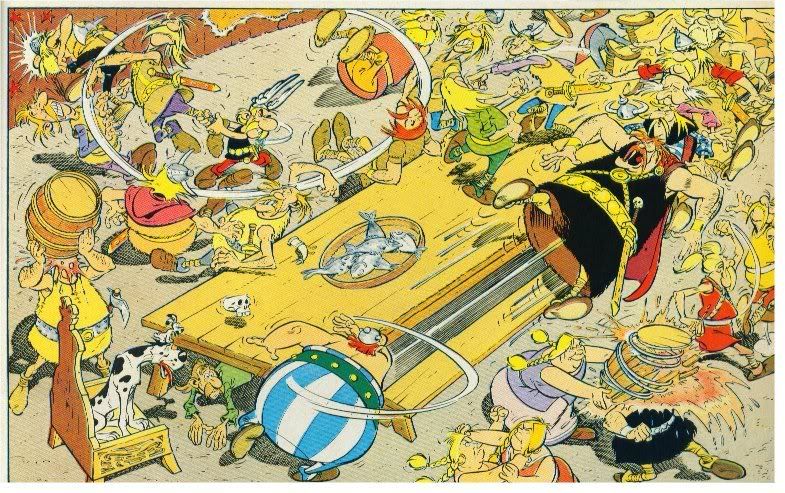
It is true that many of us who are accused of being 'self-hating Greeks' are not overly patriotic by the standards of the average Greek. Neither am I. But I do wonder what our detractors are precisely. Some romanticise our country's foibles as evidence of a 'vibrant', 'resisting', 'non-sterilised' society. They'd be even happier if they woke up to find they live in a favela, if only for a couple of hours. They imagine we're like Asterix' village, where it's OK for everyone to get high on drug-laced broth and bash at each other with iffy fish as long as it keeps those square-ass, killjoy Romans at bay. Others use any dismissive remarks aimed at our country as an excuse for not addressing the underlying issues – or engage in what I think of as Yo-mama-nomics. Other still think that, however great Greece's problems are, they are ours to deal with and must not be discussed with people who can't put them 'in context'. Kind of like a disabled son locked up in his parents' cellar. People just won't understand.
Me, I would like to think that that my patriotism is limited but healthy. Love for one's country to me should be like the love for one's mother: there will always be an instinctive, visceral bond and you will always feel compelled to stick up for your mother, but with healthy people this bond should evolve. When you're an infant it's natural to think your mother is the prettiest, the kindest, smartest and most amazing woman – in fact the only worthwhile woman – in the world. As you grow it becomes clear that she is none of these things (not to that extent anyway) and that you like to spend time with other women, doing different things – your love for your mother is rooted in affinity, gratitude and shared experience, not a lack of alternatives.
Being Greek right now is the equivalent of being the youngest son of a woman who was once a happy-go-lucky socialite with a love of wine. One who, after years of people turning a blind eye to her escalating binges, partly in order to avoid social embarrassment and partly in order to avoid losing a generous drinking partner, has finally tipped over into full-blown alcoholism. You're not a villain if you advocate treatment for her. You're not a villain if you discuss her condition with people outside the family, or if you say she needs professional help; you're not a villain if you advise people not to give her alcohol or give her drinking money. You're not a villain if you criticize her friends and your older siblings for not getting help earlier. You're also not a hypocrite if you claim the social workers on her case are inept, or if you want her off the programme and back home ASAP.
That's all I'm doing. Greece has enough tripping Gauls and frothing patriots and neither managed to keep us from getting where we are. Why not try this way?